Posts

Day 90: Judges 20-21

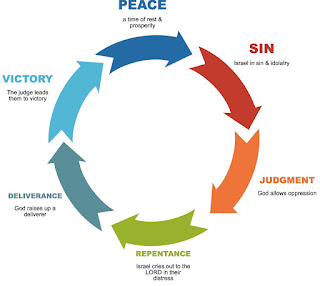
  There’s a lot to think about on Day 90 of the Bible reading plan as we complete Judges and section that maintains parity between the Hebrew Canon and traditional Protestant Canon. How did it get to the point of near-extermination of one of the tribes of Israel? (As the people asked in Judges 21:3) We have to imagine that this is the result of: Winning the war but losing the peace ( Day 83 ) Failing to thoroughly pass along their laws and experiences ( Day 74 ), leading to ignorance about: The penalty for rapists (Deuteronomy 22:20-26), homosexuals (Leviticus 18:22-30) and what a city is to do with the accused when a murder inquest is made (Deuteronomy 19:12-13). The fall of Sodom in Genesis 18, which mirrors the beginning of this story. The fall of Ai in Joshua 5, which mirrors the ending of this story. Joshua’s generalization of the principle learned at Ai, expressed in Joshua 22:11-20 on the occasion of their construction of a memorial altar at the border of the Promised Lan...

Day 89: Judges 17-19

 Why does the Levite perform such a barbaric act to send a message to all Israel? There’s so much confusion at this time, but the story is so close to Genesis 19:4-8 that the Levite must understand that Israel’s apostasy is almost complete. Travel is different today, but the Law is full of commands to be hospitable to strangers (Exodus 22:21, 23:9; Leviticus 19:10, 33-34; Deuteronomy 10:19). This horrifying story has no one who consistently shows pity - even the hospitable Ephraimite was willing to sacrifice his virgin daughter, (Judges 19:24), as Lot was (Genesis 19:8). The story is meant to horrify us-in doing what is right in our own eyes, (Judges 17:6), we lose compassion and all sense of what is right. We’re not too far from this today. Modern people in their pride have banished God’s Word from public life and feel confident that they can create a framework that is enlightened, compassionate and just. It’s predictable that it will descend into darkness, mercilessness and injus...

Day 88: Judges 14-16

Image
  Does the theory that Samson’s life is a picture of Israel hold up over his marriage & annulment/divorce, later dalliance with a prostitute then enticement by Delilah, and captivity? The idolatry (which is often pictured as fornication/adultery/illicit sex in the Old Testament) is obvious in Judges. In the later history it isn’t always as obvious. For instance, you’d think that the reign of Josiah was a golden age. He was the best king Judah ever had (2 Kings 23:25), and yet the great apostasy that brought on the ultimate captivity came during Josiah’s reign. (Jeremiah 1:2, 25:3) So although there were cycles of comparatively better or worse leadership, there was always a lot of secret idolatry. (2 Kings 17:7-23) If the theme of Judges is “the need for a king” and the theme of I & II Samuel,I & II Kings are the rise and demise of the kingdom, what is Samson, the last of 12 judges, showing us? There is a need for a king—when Samson is at his best, he’s still deli...

Day 87: Judges 11-13

The older I get, the more the story of Samson bothers me. Why is so much of Judges devoted to his story, while an earlier judge who kills 2/3rds as many Philistines in a similar way merits only a brief mention? Why is he constantly chasing Philistine women around, when the command not to intermarry is so clear and he's set apart from God for purity before his birth? Why is his mother not named in the narrative, even though she seems to be the parent with any spiritual discernment? Why is the angel so shy about his name? Is it a pre-incarnate appearance of Christ? (He says his name is "secret" which could be translated "wonderful" - see Isaiah 9:6) He's in a short list with Isaac, John the Baptist and Jesus Himself of pre-announced births, but his life seems to mark a severe downturn in the already-depressing story of the Judges.

Day 86: Judges 9-10

Since its predictions came to pass (Judges 9:20), is it not fair to say that Jotham's parable is a divinely-inspired prophecy? I've always thought it was insightful; but the more I think about it the more I get out of it. The productive trees are unwilling to stop doing what they're good at in order to assume leadership. It's common for diligent people to feel this way, but it makes room for those "vain and light persons" (Judges 9:4) to assume power by blind ambition and through cronyism (Judges 9:3).

Day 85: Judges 7-8

Image
  We’ve already seen that something is wrong with Israel’s diligence in conquering the land and driving out the people of Canaan. Something is wrong with their central worship. In these chapters, is something wrong with their internal unity? The men of Ephraim threatened Gideon and his army. (And Gideon was from the tribe of Manasseh, the brother of Ephraim!) The  men of Succoth and Penuel refused to feed them while they were in the process of delivering Israel from the Midianites. (Midian means "strife") It seems Gideon unified the nation, yet for all his refusal to be made king, he names the son of his concubine “My father is king” (Judges 8:31) and led the land into an idolatrous divination regarding the golden ephod he made. Once Gideon dies, the people turn again to Baal, and Gideon’s very nickname came from his destruction of the altar to Baal in Judges 6:25-32.

Day 84: Judges 4-6

  Do things seem strange in these next few chapters? Shamgar, the third judge, got mentioned in the final verse of Chapter 3, and then there’s this reference to evil arising again once Ehud  is dead. Ehud, of course, is the second  judge, so what a strange point to make, that Shamgar arises after  Ehud, but it’s after the death of Ehud that the Israelites returned to evil after Ehud’s death. Shamgar is not a Hebrew name, and calling him “Son of Anat” could very well be a reference to the Canaanite goddess Anat, who was the consort of Ba’al. Then there’s Deborah, who is said to be a prophetess. Why is a woman judging Israel? And Barak refuses to go to war without her. Even Deborah appears to recognize the shame of his reluctance to take leadership. (See Genesis 3:16) When Gideon is called, the angel instructs him to build an altar made from the scraps of the Asherah poles and the altar of Ba’al, then offer the bullock he uses to tear it down as a burnt offering. Un...

Day 83: Judges 1-3

  From passages like Judges 1:19, 21, 27, 29-35, 2:1-3, 10-15, 20-23, 3:3-7 can we conclude that Israel "won the war but lost the peace", as we say? I think the whole idea that we’re people who are too short-sighted to be naturally aligned with God’s vision is a profound one, and one that should motivate me more to be filled with His Spirit, Eph. 5:18), so that I’m aware of the opportunities He presents to me, (John 5:20), willing to do what pleases Him, (Philippians 2:12-13) and resistant to every form of temptation (Galatians 5:16) including that of slackness. (Joshua 18:3) Meanwhile one implication of the Exodus that I hadn’t considered in quite this way before: the world wants our firstborn . God prompts us to prepare them by telling them the story of our faith: Exodus 10:2, 12:26, 13:8-14; Deuteronomy 4:5-14, 6:2-25, 11:18-23; 32:44-47; Joshua 4:5-7. How can I memorialize what God has done in my life for future generations of our family in a meaningful way?

Day 82: Joshua 22-24

The altar "Ed" and Joshua's stone at Shiloh were set up to commemorate the people's pledge to serve the Lord only. While they did, God blessed them and fought for them, and they could boldly say that no good promise He made them failed. What a witness to future generations. Did they quickly forget the other side of Joshua's promise? (Joshua 23:15-16) Not in the lifetime of Joshua and his contemporaries, (Joshua 24:31), but extending faithfulness beyond them was the point. How can I extend what I have witnessed of God's faithfulness beyond the lifetime of my contemporaries?

Day 81: Joshua 20-21

After 45 years on the march (Joshua 14:10), settling into the land with no remaining enemies must have been amazing. They could then look back and say that every promise of God had been fulfilled. I think the only comparative statement is when Solomon claims to have rest on every side. (1 Kings 5:4; 1 Chronicles 22:9; 2 Chronicles 14:7) By contrast, Paul has no rest, but trouble on every side: fightings without, fears within. (2 Corinthians 7:5). If God's calling for me is suffering and trouble, spiritual warfare, is it laziness, cowardice or idolatry to long for that peace and rest?

Day 80: Joshua 18-19

Does it seem anticlimactic to have such a matter-of-fact statement about the placement of the Tabernacle and the victory over the land? What about the ceremony to set it up? What about the offerings and the presence of God? Did the cloud come over the location? Did smoke fill the Holy place? Maybe I'm reading too much into this, but it seems to me that their slackness to take full possession of the land was associated with their slackness in worship. The Tabernacle will be here for hundreds of years, until its capture by the philistines in 1 Samuel 4 at the end of Saul's reign. So it was to be the center of their religious life, where offerings were to be made and the priesthood was to minister.

Day 79: Joshua 16-17

As Joshua begins to assign the inheritance after God's instructions in chapter 13 and delegate the tribes to take possession of their lands, we begin to see the first pockets of failure in Joshua. (Joshua 13:13, 15:63, 16:10, 17:12-13, 16) Was it because they had too much dependence on their human leader and not enough dependence on the Lord?

Day 78: Joshua 14-15

Did Caleb's bold request (Joshua 14:12) inspire Othniel? (Joshua 15:16-17) Did it inspire Achsah's? (Joshua 15:19) Did she see in his offer of his daughter  to the man who took  Debir a desire to get a courageous and faithful husband for his daughter and to ultimately give  Debir to his daughter , and then ask for more , out of confidence that he was predisposed to give her what she wanted? How many things do I miss out on because I think my Father has given me enough and so I fail to ask?  (Luke 11:9-13; Romans 8:32)

Day 77: Joshua 12-13

  With the benefit of knowing the rest of the story we understand what God is anticipating in Joshua 13:1-6, when pointing out Joshua’s age and the great number of Canaanite nations remaining to be driven out. Joshua had led the defeat of 31 kings (Joshua 12) and Ussher estimates the book of Joshua to cover 27 years. Judges follows and covers 305 years of rapid decline. The Canaanites and Philistines figure prominently in the stories of Judges. Joshua is so devoted to the Lord, so courageous and industrious… if he fell short, what do we need to learn from this? First, to see the great example of Joshua’s instant obedience: he left nothing undone of what God through Moses had commanded him. (Joshua 11:15) It wasn’t because he was disobedient or reluctant to do what he was called to do. (Compare with Jesus’ statement in John 17:4) We must learn also from the great devotion of Joshua. When the Tent of Meeting was set up, Moses had  to go in and out, to convey God’s directions to...

Day 76: Joshua 10-11

Was it the heart to do all that he'd been commanded to do (Joshua 11:15) that moved Joshua to ask the Lord to hold the sun so that the army could make a 25-mile journey and destroy their enemies in a single day? It stands in stark contrast to the apathy of Jehoash in 2 Kings 13:14-19 which angered Elisha. May we all recognize the spiritual battle we are in and seek the spirit of Joshua.

Day 75: Joshua 7-9

Did the Gibeonites survive because of their deception? It seems that they did; even after the Babylonian Captivity a Gibeonite is mentioned in Nehemiah 3:7. In 2 Samuel 21 we see that the princes of the congregation were right to spare them after having made the mistake of not seeking the Lord's counsel and swearing in His name, for when Saul tried to destroy them, he brought a famine on Israel. So by God's mercy it seems they were fully incorporated into Israel.

Day 74: Joshua 4-6

Isn't the Gilgal incident empirical proof that the Israelites were not teaching their children as they'd been commanded? (In Exodus 10:2, 13:8-14; Deuteronomy 4:5-14, 6:2-25, 11:18-23; 32:44-47) So when Joshua makes the commandment concerning the stones from Jordan in Joshua 4:5-7, the literal object-lesson would have been part of a huge (risky and costly) lesson for the Israelite children. After crossing over Jordan, the fighting men are circumcised (risking vulnerability Genesis 34:13-29), they celebrate Passover, the Manna ceases (their food source for their entire lives) and they have a supernatural victory over the first fortified city in Canaan.

Day 73: Deuteronomy 34 - Joshua 3

Why are we not told the names of these two faithful spies, but are told the name of the two faithful spies of Numbers 13-14? Rahab is recognized as the more important person here. She's the first recorded Gentile convert to Judaism and becomes the mother of Boaz, (Matthew 1:5), the redeemer of Ruth and grandfather of King David.

Day 72: Deuteronomy 32-33

How much time does the book of Deuteronomy cover? My Scofield Reference Bible has the same date for the whole thing, and I'm inclined to accept that it's essentially one long sermon from Moses just before he dies and the Israelites pass over Jordan. That would make almost 25% of the Torah just Moses' final exhortations to the children of Israel. The Gospel accounts of the final week of Christ's life make up about a third of the Gospels. Like Moses' teachings here, the final chapters of the Gospels give the Disciples promises, warnings and prophecies about their future, and form the basis of the rest of the New Testament. The Torah is the Law is Israel, her "Constitution," as a nation, and the basis for the allegations made by the Prophets against her when she violated them, (as recorded in the "Writings").  So this is another way Jesus was a " prophet like Moses. "

Day 71: Deuteronomy 30-31

I wonder how modern Jews feel when they read this section? It all came to pass just as God revealed through Moses - after conquering the land and settling down they quickly turned aside into idolatry (Judges 17). Yet He also anticipates the new covenant of Ezekiel 36:24-33 & Jeremiah 31:31-34 in Deuteronomy 30:6 after a dispersion and regathering.